At home, I have a Steinway. On that instrument, I learned to play the piano and I believe it is one of the most beautiful instruments around. When I was about twenty years old, I was fortunate to encounter “authentic” instruments, romantic pianos like Erards and Pleyels and even older instruments like Grafs and Streichers. It was a discovery of a completely new world of sounds and expressive possibilities. Of course, I took the inspiration and revelations that I received from these instruments with me to the modern piano. This resulted in a stimulating cross-pollination of expression and interpretation. Thus, it became more and more self-evident for me to perform the same repertoire on both old and new pianos.
I have always avoided the question whether a composer’s music should only be performed on a historic or modern piano. Performance practice has always been a living and dynamic concept through the centuries. The pianist of today has access to a wide range of instruments and he has the privilege of being able to choose from both the major “traditional” school of piano playing and the authentic school of performance practice which sprang up in the 1970s. The pianist of today is as much a child of Richter, Rubinstein and Kempff as he is of Harnoncourt and Leonhardt. There is no reason why a present-day pianist cannot justify Schumann as easily on a Streicher as he can on a Steinway (or the other way around). Having to choose one world to the exclusion of the other means giving in to a dogma and losing the wealth of experience that a combination of both worlds can offer.
There are certainly pianists who bridge the gap between old and new instruments, but unfortunately this is not a common phenomenon as yet. Pianists tend to belong to one side or the other, and travel between the two certainly cannot be taken for granted. While the music world has accepted this for many years with respect to other instrumentalists, pianists still tend to be assigned to one pigeon-hole or another. Therefore, I hope that the day will come when no one is surprised if a piano recital is performed on several instruments, even if the program is confined to the works of a single composer.
Paolo Giacometti - pianist
Thuis heb ik een Steinway, daar heb ik het pianospelen op geleerd. Ik vind het één van de mooiste instrumenten die er bestaan. Rond mijn twintigste heb ik het geluk gehad in aanraking te komen met ‘authentieke’ instrumenten, romantische vleugels als Érards en Pleyels en nog oudere instrumenten als Grafs en Streichers. Een nieuwe wereld aan klanken en expressieve mogelijkheden ging voor mij open. De inspiratie en de openbaringen die deze instrumenten mij gaven nam ik uiteraard mee naar de moderne vleugel. Er ontstond een stimulerende kruisbestuiving aan expressieve en interpretatieve mogelijkheden. Zo werd het voor mij steeds vanzelfsprekender om hetzelfde repertoire zowel op oude als op nieuwe piano’s uit te voeren.
De vraag of het werk van een componist alleen mag worden uitgevoerd op een instrument uit zijn tijd of op de moderne vleugel ben ik dan ook altijd uit de weg gegaan. De uitvoeringspraktijk is door de eeuwen heen altijd een levend en dynamisch gegeven geweest. De pianist van nu heeft een zeer rijk instrumentarium tot zijn beschikking en heeft het voorrecht te mogen putten uit zowel de grote ‘traditionele’ pianoschool als de authentieke uitvoeringspraktijk die in de jaren zeventig is ontstaan. De pianist van deze tijd is zowel een kind van Richter, Rubinstein en Kempff als van Harnoncourt en Leonhardt. Er is geen reden waarom de hedendaagse pianist niet evenveel bestaansrecht aan Schumann kan verlenen op een Streicher als op een Steinway (of andersom). Het moeten kiezen voor de ene wereld of de andere betekent het kiezen voor een dogma en het verlies van de rijkdom van de ervaring en combinatie van beide werelden.
De pianisten die de brug slaan tussen oude en nieuwe instrumenten zijn er wel, maar het is helaas nog geen gemeengoed. Pianisten behoren tot het ene of het andere kamp en heen en weer reizen tussen die twee is bepaald geen vanzelfsprekendheid. Daar waar de muziekwereld dit al geruime tijd accepteert van andere instrumentalisten, heerst wat betreft de piano nog steeds een hokjesmentaliteit. Ik hoop dan ook dat de dag komt dat niemand er meer van opkijkt dat in de grote zalen een pianorecital op meerdere instrumenten plaatsvindt, zelfs als slechts werken van één componist op het programma staan.
Paolo Giacometti - pianist

Paolo Giacometti
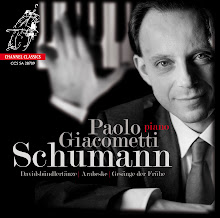
Paolo´s new cd on Channel Classics: CCS 28709

The Érard masterclass took place in the beautiful 'Maison Érard' at the Keizersgracht in Amsterdam, for more information click on the image
